Many descriptions come to mind when I think of Asiatic Jasmine...fast growing, pretty foliage, drought tolerant, tolerates sun and shade, and so on. While this plant may not be for everyone, especially if you are looking for plants that require "no attention", this little gem just might be a plant to work into some situations in your landscape. 
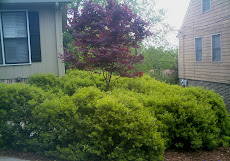
Asiatic jasmine is a ground cover that forms a thick carpet of shiny, evergreen leaves. It grows to a height of anywhere from 4" to 12+" as a ground cover, but can grow up a wall or down from a hanging basket or the top of a wall by as much as 10+'. Along a side walk or up against a house, the vine-like nature of this plant will require some maintenance. You may want to prune the jasmine to keep it from growing up the outside walls of your home and into the crevices of your windows, especially if they are within one foot of the ground. Along a sidewalk, an occasional trimming will keep things looking neat. Asiatic jasmine is tough, so it will tolerate heavy pruning, weed eating, or even pruning by mower (never thought I utter those words!).
One of the best things about Asiatic Jasmine is that it is quite pretty. A nice planting surrounding an accent stone, small specimen tree or garden art is quite a nice touch. This specific jasmine (scientific name Trachelospermum asiaticum) can bloom on long stems, but typically, you will not have flowering. It's just an elegant, yet strong plant (Zone 7-10) that can adapt to a variety of situations. You should give it a look for your landscape. It's certainly a plant I use from time to time in my exploits as a plants man.
Several varieties of Asiatic jasmine are available, including variegated forms and dwarf types. A great plant for erosion control.
Thursday, May 15, 2008
Vigorous Ground Cover = Asiatic Jasmine

Saturday, May 10, 2008
My Mom: Queen of the Jungle

Under the old Pecan tree at her Aunt Rachael’s house was where she pretended to be Sheena, Queen of the Jungle. My mom played and dreamt and found comfort there along with her trusty canine companion, "Boy". Growing up in Texas and living their, now, my mother gained an appreciation for plant life and has become quite the gardener so I thought I’d post some of her gardening thoughts by virtue of an interview she unknowingly (I know, mom’s always know!) gave me last night on the phone.
MFE(manfromearth): So mom, do you have any early childhood memories that have to do with plants?
MOM(my mom): Well, of course, I remember the pecan tree at Hershel and Rachael’s house. They didn’t have many plants, but there was a fig tree and Uncle Hershel grew vegetables. And, oh yes, the lantana bush! I was telling Darlene, a fellow nurse that I used to work with about the plant and she said, “Melba, that sounds like a lantana”. She went home and gave me a piece and I just grew it.
MFE: What are you growing in your yard this spring that you find particularly interesting?
MOM: I love the Hibiscus. I’ve got red, salmon and pink in my back yard where it’s sunny. I’m also growing Mexican petunias (see picture to the right) and plumbago (see picture below).
MFE: Mom, those plumbago will be blooming soon, right?
MOM: No, they are in bloom now. I have impatiens that came back from last year and also geraniums, marigolds, and Mexican heather.
MFE: And is George growing any vegetables, mom?
MOM: Yes, he has pots with squash, tomatoes and peppers.
MFE: Sounds like you have lots going on in your yard to keep you busy.
MOM: I have red tips in my back yard that are growing so tall that I can walk around in my nightgown.
MFE: Mom!
So, there you have it. My Mother’s Day garden interview with my mom.
Happy Mother’s Day!
Tuesday, May 6, 2008
Recommended Quick Trip
 Maybe not real quick, but worth the five hour drive from Birmingham. It's Dale Hollow Lake. It's been a while since I visited, but I'm betting the lake is still beautiful and in a pristine state.
 {Note: I just checked and it is indeed still in a pristine state} Dale Hollow Lake is actually under jurisdiction of the Army Corp of Engineers, so there are no homes dotting the shore line of this waterway.
  As the official site of Dale Hollow Lake explains, "Come float the pristine waters and relax, surrounded by the sounds of nature. There are no McMansions staring you in the face as you cruise the peaceful lake. It feels like you are back in time, back to a virgin forest with an unspoiled lake teeming with fish". I remember renting a house boat at East Port Marina, in North Tennessee, for a few nights as part of a family vacation.
The night sky was incredible and the everywhere you looked was just gorgeous, and not an exceedingly crowded lake, either. Plenty of solitude to be enjoyed. Vacationing in a house boat on an awesome lake, like Dale Hollow, is something I'd definitely recommend. The Suncruisin2 - still slicing through the waters of Dale Hollow Lake!
Saturday, April 26, 2008
Happy Birthday to Marge!
She is a great plant person with a fantastic collection of indoor plants and an awesome looking deck with patio plants and flowers galore. She really does have a green thumb and seems to have a special connection with the plants she grows. As a great grandmother, Marge is very active and I have to think that being around plants and working with them is one way she's accomplished this. You've always been an inspiration to me and a joy to be around.
Tuesday, April 15, 2008
A brisk, sunny day in Vestavia, Alabama
A very nice couple and long time clients of mine allowed me to plant some of my favorite plants for them a few years back. Today, I stopped by to do some pruning and thought I'd take some pictures of a few of the plants that were looking especially nice. 
When it comes to pruning, I try to make my cuts in such a way as to promote the health and looks of the plant. I'm a big believer in hand pruning (with my trusty Felco pruners) as opposed to using shears, electric or otherwise, because you have so much more flexibility. If you are trying to get a natural looking pruning job when pruning Hydrangeas, for instance, shears are just not going to get the desired effect. Even with hollies such as these Needlepoint hollies in the picturee above, using hand pruners allows you to make cuts deeper inside the plant while still maintaining a manicured look, if that is the desired result as it was with these. And as always, I do my best to prune in such a way as to have plants such as these stay bushy all the way to the ground. This is what you want when pruning plants along your foundation or fence. Much of the same principles go for the pruning I did on the Green Robusta junipers, as well, except fot the exception of making deep cuts. With almost all conifers, such as cypresses, cedars, and junipers, you've got to be careful not to prune into wood that is too thick. They just don't respond well to heavy pruning.
OK, enough on pruning! Here are a few plants at this Vestavia home that I thought you might enjoy seeing:
Green lace-leaf Japanese maple. I planted this plant about 5 years ago. As I remember, it was a two gallon plant and was probably no more than 2' tall by 2' wide when I planted it. It is slow growing, but has managed to grow nearly 4' tall by 6' wide. Red varieties of Japanese maples get all the love at the local nurseries, but the green fellas have a lot to offer, as well, including outstanding fall color and a nice contrast to other plants such as these Parson junipers that are planted around it. 
Lady Banks rose is a thorn less rose that is well suited for trellises and training on walls. The garage door was such a big part of the front of this home that we felt something growing up and over it would help provide a soft effect. Lady Banks rose only blooms once a year, in the spring, but the flower show lasts for a good three or four weeks and the plant is evergreen. Another good reason to consider it. The homeowner has done a very good job of keeping it growing over the garage doors (in this case, with masonry nails and ties) and it requires some pruning of limbs when they hang too low. Lady Banks rose is available in yellow and white blooming forms. 
And finally, the ol' standby for what to use as a small tree in a small yard has to be Bloodgood Japanese maple. When I planted this tree five years ago, it was probably about four or five feet tall with limited branching. One key to the success of any tree planted in a turf situation is to create a mulch ring or mulched natural area around the tree which eliminates mower or weed trimmer damage. As far as pruning goes, I occasionally remove lower branches so mowing isn't a hassle and to allow light to the grass below. There are lots and lots of worthy upright red Japanese maple varieties to chose from and Bloodgood is certainly the grand daddy of them all and continues to be a great choice for the landscape. 
Thursday, April 10, 2008
Once a year

Once a year, this special plant, a gift from my friends Joe and Ann, blooms without fail. The plant is tropical, so I keep it inside during the winter. The blooms are awesome and the show will last several weeks. I thought I'd share the beauty of this plant to all visitors. I hope you enjoy it! Of course, Joe and Ann told me what kind of plant this is, but I am suddenly afflicted with memory loss. When I find out, I'll let you know. Or better yet, does anyone know what it is?
UPDATE: I have had correspondance with Joe and Ann! Ann says the plant is called Clivia. I knew that! After doing a little research, I'm finding that there is a cult of Clivia lovers all over the world. Clivia is considered a prized indoor plant and valued for it's beautiful blooms. While the orange flowering variety is most common, there are yellow and even pink blooming Clivia plants, as well.
Friday, April 4, 2008
Mortar-less rock wall
 Last November, I constructed a rock wall for some very nice folks in Homewood. They were initially considering a wall made from one of those segmental retaining wall systems....like Keystone, Geostone, etc. One advantage of using those is that they are, genreally, easy to erect and they need no mortar. The material is not cheap (relative to other materials), though, and the look is, how should I say,,,not very organic. I convinced my clients to give natural stone a try and they have told me they are happy they made the choice.
Constructing a mortar-less stone wall that is over 3 or 4 feet tall requires some careful considerations. For one, the amount of loose backfill to be placed behind the wall plays into the size of the stone chosen. By the way, we decided to use a brown rubble stack stone for this project. Most of the stone I used for this wall was three to six inches thick by ten to eighteen inches long by eight to twelve inches deep (some deeper for extra security). Sidenote: When I call my stone provider, I like to throw them a loop and ask for stone that is the size of something off the wall, such as a brief case or a toaster or a mail box. I usually get an uncomfortable pause (no telling what they're thinking!), so I always give them some actual measurements, too. 
The basics of wall building come into play and must be adhered to, also. They include preparation of a foundation, including several inches of gravel base; backfilling with gravel; baffling the stone as the wall is being built. Other things, such as parallel placement of the stone, securing the top of the wall with substantial stone pieces, and creating pleasing lines when designing the wall are important. 
Finally, the finished product achieved my clients objectives. It helped to create a level area for their son to play on and it added positively to the overall appearance of their backyard.
ps...You can click on any picture that is included as part of one of my posts to get a larger view.