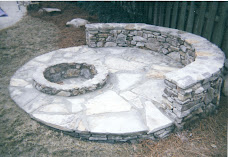
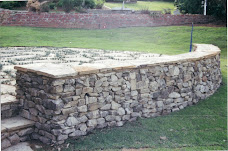
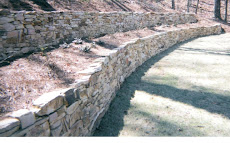
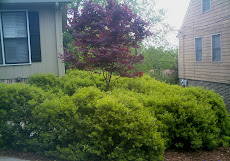
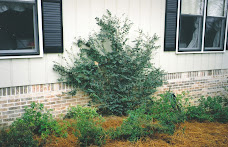
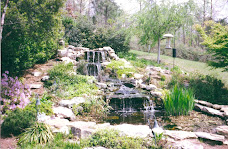
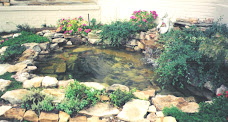
Just South of Birmingham in a quiet neighborhood just off hwy. 280, I met a very nice couple that was interested in updating the entrance to their property by incorporating stone and some new plantings. The area in question was not draining very well so it was deemed important to create a raised environment for the Ruby Slippers hydrangea and Georgia Blue Veronica we'd be installing for the project. Here are some before and afters. I'm hoping to get some additional pictures when the hydrangeas leaf out and bloom.
Tuesday, April 5, 2016
Stack medium moss rock entrance planters w/ Ruby Slippers hydrangea
Posted by
themanfromearth
at
6:06 PM
1 comments
Labels: deciduous landscape plants, drainage, stone work
Wednesday, May 27, 2009
Cleaning out the picture phone...
My phone is getting old, and it's gritty because of the work I do. I've actually completely submerged this phone in water, twice, once for about 5 seconds and again for about 2 seconds. The picture quality isn't the best, but it's convenient and I see things I just want to capture from time to time. I haven't downloaded pictures from my phone since the last snow (late 2008/early 2009 ???) so I wouldn't call some of these shots particularly timely, but here goes anyway:
PHOTO: One of my favorite trees. Chinese fringe tree, scientific name, Chionanthus retusus, is a wonderful flowering small tree. Not to be confused with American fringe tree, scientific name, Chionanthus virginicus, which is native to Alabama, Chinese fringe tree offers bountiful blooms and retains a nice natural shape. There are not enough of these trees being produced by good growers, so when I see a nice specimen, I try to find a home for it.
PHOTO: Simple rock border I installed for a front landscape in Greystone
PHOTOS: Weeping pussy willow

PHOTO: Snowy woods in Alabama
PHOTO: Mary praying in the snow
PHOTO: Holly berries from my yard awash in snow.
PHOTO: Extreme crepe murder! (not by my pruners, in case you wondered)
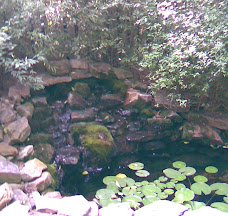
VIDEO: These are my little buddies, swirling around some food. They live in my pond that I'm building at my home...currently, still, otherwise, eternally soon to be finished...I am determined not to become the cobbler!
Posted by
themanfromearth
at
5:57 PM
0
comments
Labels: deciduous landscape plants, Rob's musings, stone work, video clips
Wednesday, March 25, 2009
Top Ten Crape Myrtle No-No's

Crape myrtles are popular in our region of the mid to lower South and rightfully so. Unlike the in vogue nature of plants such as Bradford pear and Leyland cypress, crape myrtles actually have positive ornamental characteristics that far outweigh any negatives associated with this Southern horticultural heavyweight. Among the characteristics that have many wanting at least one crape myrtle in their yard are the distinctively showy blooms, the exfoliating bark that ultimately reveal an often colorful muscular trunk, and the superb fall foliage that can range from delicate yellows to intense reds. When it comes to negatives, the crepe myrtle itself can usually be held without blame. Many times, it is the owner of the crape myrtle that has committed the no-no, and so, without delay, here is my list of the Top Ten Crape Myrtle No-No's:
PHOTO: Nachez crape myrtle - possibly the most used and well-known of all crape myrtle varieties.
10. Selecting a plant that requires massive pruning to fit into it's space - Today's crape myrtle is much different than those that our parents enjoyed. We have a multitude of varieties available to us with enhanced cold tolerance, improved insect and disease resistance, and most importantly, we have crape myrtle varieties that, at maturity, grow as small as one foot tall, to giants that can reach 40' tall. With all these choices, it is upon the designer/installer to chose the appropriate plant. For instance, if you have a space where you want a white crape myrtle that grows to about 10' tall, then you should be looking for a semi-dwarf variety. Named crape myrtles usually are tagged with information that tells you how large they are going to grow or you can do a little research online and find out what varieties fit the parameters you've set up. When looking for a white crape myrtle that grows 10' tall at maturity, you don't want to buy a Nachez, for instance. Nachez crape myrtles will grow over 30' tall and will quickly become too large for your space. The better choice would be one of the white semi-dwarf crape myrtles, like Acoma.
9. Buying a plant labeled red or white or pink or purple - I've seen this from time to time. A crape myrtle simply tagged, "pink". This is a sure sign that you are probably not purchasing an improved variety and it is your guess as well as anyone else's as to how large it's going to grow. Your best bet is to steer clear and seek out a named variety.
8. Not buying a plant that is insect or disease resistant - Insect and disease has, in the past, been quite the bugaboo for crape myrtles. Aphids and powdery mildew were among the most bothersome agents of doom when it came to crape myrtle decline. Now, with improved varieties available to the public, you can pretty much purchase crape myrtles secure in the thought that they will grow well and you won't be treating them every growing season. Of course, the disclaimer is: nothing is absolute and sure as I talk about improved insect and disease resistance, there are isolated cases. Crape myrtle lists are out there that will signify certain varieties as being more hardy than others if you really want to cover all your bases.
PHOTO: Tuscarora crape myrtle - Here it is used as a street tree. Tuscarora crape myrtles will grow to 20' tall by 15' wide and have huge flower panicles (12" by 8") that are dark coral pink for about 70 days during the summer. Nachez, Tuscarora, Tonto, Souix and a score of other crape myrtles are from what is referred to as the Indian series. This series of crape myrtles is readily available at reputable nurseries and are highly recommended.
7. Improper spacing - When planting a grouping of crape myrtles, attention should be paid to spacing. One characteristic of crape myrtle that can be enjoyed is the graceful branching habit. A way to diminish this characteristic is to plant too closely together and planting too closely together inhibits air circulation (which is helpful in fending off disease) and makes the landscape appear cluttered. As I've mentioned, every crape myrtle has a mature height it will grow to, but they also have a range that they will grow to in width. For example, Acoma crape myrtles are usually listed as growing to about 8' - 10' high and to about 10' - 12' wide. So, if you are planting a grouping of three Acoma crape myrtles, you probably don't want to plant them closer than 10' or 12' apart.
6. Planting in too much shade - I've seen crepe myrtles growing in too much shade and they always look unhappy (yes, I occasionally think of plants as having human emotions :-)). Now, a crape myrtle will grow nicely in just a little shade, but know that the more shade it is subjected to, the fewer number of blooms you will have, the less foliage you will have during the growing season, and the more the crape myrtle will grow leaning toward the sunlight.
5. Not keeping your crape myrtles pruned up - As you will see when you get to rule No. 1, I am not a big fan of pruning crape myrtles. I do, however, encourage limbing up and the removal of dead and intersecting branches. The limbing up process does not apply so much to the more dwarf and shrub varieties of crape myrtle and much as they do to crape myrtles that you want to look like multi-trunk or single trunk trees. The limbing up procedure is where you take smaller limbs growing out from a main trunk and prune them off flush with the main trunk. These limbs are typically going to be located on the bottom 1/3 of the plant and, when removed, give the crape myrtle more of a tree-form appearance. Also, removing dead limbs and branches that intersect, rubbing against each other, is a way to improve the overall health and attractiveness of the crape myrtle.
4. Underplanting with too much plant - I most definitely encourage underplanting crape myrtles, especially when they are planted in natural areas or as part of a foundation planting. What you want to avoid, though, is underplanting with material that overwhelms the crepe myrtle. For example, large hollies or conifers don't look good under crape myrtles. Try using low growing plant material to plant under a crape myrtle. Ground covers and other low growing plants are great to plant under crape myrtles (Asiatic jasmine, English ivy, Autumn fern, dwarf azalea, etc.).
3. Clashing colors - When it comes to crape myrtles, too much of a good thing isn't necessarily good. Typically, in my landscape designs, I may have a singular crape myrtle plant or perhaps a grouping of several crape myrtles of one variety, but rarely do I incorporate multiple crape myrtle plantings of different varieties. If you have a grouping of red crape myrtles in your yard, for instance, and you insist on going with another grouping of a different color crepe myrtle, you might avoid using purple. More importantly, I would keep in mind the colors in your landscape in relation to when and where your crape myrtle is blooming. For instance, you may not want to plant summer blooming yellow hypericum under your Souix crape myrtle unless you enjoy the interplay between a medium pink and yellow. Opinions about colors in the landscape are of a subjective nature and all I can do is offer my opinion. I lean toward what I'd call "kinder combinations" with white being the great equalizer. I prefer using different shades of pink together or white with just about any other color. I'm OK with magenta combined with pink while I try to stay away from purples with red, lavenders and pinks with yellow, etc.
PHOTO: Chickasaw crape myrtle - a dwarf variety. This established plant from an Auburn University research center in about 2' tall.
2. Having a rogue crape myrtle - Seeing a planting of 4 pink crape myrtles and 1 purple one is more of a pet peeve for me than anything and it is often beyond the buyer's control. Sometimes plants simply get tagged incorrectly. With crape myrtles, when you are buying a group of one variety, take the time to examine each plant, even if they are tagged the same. You can sometimes spot a rogue plant by noticing that its habit of growth is different from the others or the leaves seem to be of different size or, if it is fall, that the fall color of one plant is different from the others. Still, if you realize that you've got a wrong colored crape myrtle....please! Replace it!!! (How's that for drama?).
1. Crape Murder - Who ever came up with that saying has given landscape professionals a catch phrase for the ages. And why not? When you top a crape myrtle, you are acknowledging that your crape myrtle was not properly selected or that you are a status quoer! (I just invented a word!!!). If you are a crape murderer, I still love you. I just don't want you within a mile of my yard if you have pruners on your body. :)
Posted by
themanfromearth
at
12:55 PM
344
comments
Labels: crape myrtle, deciduous landscape plants, landscape tip, pruning, trees
Thursday, December 11, 2008
Parking Pad/Pathway Job Walk Through
The last couple of weeks or so, in between rain and cold (for Alabama), I've been in Homewood working on the installation of a parking pad, flagstone walk, and a stepping stone path.
The objective, initially was to find a spot for a car new to the family. Yes, a teenage driver (insert Bates Motel music)!!!
We decided to surface the pad with an 8910 gravel which was chosen because of the particular quarry it came from. This gravel has a slightly tan color and is not as stark as the typical gravel you buy from suppliers. Also, using 8910 gravel, which will pack down and offer an excellent surface for parking, is economical, and at the same time, attractive and functional.
The parking pad was bordered, on the lawn side, with a stone soldier course. Those stone, most of which are exposed 3 inches above the grass line, have nine plus inches buried and surrounded with cement and mortar. Careful attention was used in selecting the soldier course stone so that, one, the colors matched with the walkway, and two, that the length and thickness of the stone fell in place with the over all scale of the entire project.
The flagstone walkway was installed using a combination of stepping stones that were previously used for traffic from the drive to the front door and from stones the homeowner had left over from previous work on the house. Using the two different types of stone actually made for an interesting combination that worked well together.
The stepping stone path was chosen to provide access from the pad to the front door. As usual, I tried to steer away from straight lines, trying to make the pathway seem more "organic".
PHOTO: Crimson Queen Japanese maple
Finally, a planting bed was created at the head of the parking pad to help direct foot traffic and help soften the over all project. The homeowner has already bought a 'Crimson Queen' Japanese Maple to plant in the bed. It should really enhance the entire job.p
Posted by
themanfromearth
at
9:44 PM
0
comments
Labels: deciduous landscape plants, patios and walkways, project showcases, stone work, video clips
Thursday, September 4, 2008
A Beauty of a Berry
PHOTO ABOVE-Callicarpa americana
I have several memories of specific plants that go back to before I actually thought plants and nature in general would become a big part of my livelihood. One of those memories goes back to when I was a young teen. I remember spending some time at Logan Martin Lake, near Pell City, AL, with my family on the weekends. I enjoyed walking the woods that stretched above the banks of the lake, checking out all manner of interesting flora and critters. American Beautyberry is a plant that I remember growing in those woodlands. How could you not notice those striking purple berries in late summer or early fall? There simply isn't another native plant quite like it. I find beautyberry to be a plant that should find a home in many yards, as well. The plant is native throughout the Southeast and growing it here in Alabama shouldn't be a problem. I have found that growing Callicarpa (the genus for beautyberry) is relatively easy. It isn't particularly finicky when it comes to soil type, sun exposure, or moisture requirements. If you happen to live South of Birmingham, and especially if you live South of Montgomery and into Florida, you may just find your beautyberry to be quite the spectacle. While vacationing in the panhandle of Florida, several years back, I noticed several native beautyberry growing magnificently. I suspect beautyberry enjoys the warmer surroundings, even though it is listed as a Zone 5 plant.
While American beautyberry (scientific name, Callicarpa americana, also known as purple beautyberry) is probably the most familiar of Callicarpa species in these parts, there are other species to note:
PHOTO RIGHT-Callicarpa dichotima - a more compact plant than Callicarpa americana and is known to produce more berries, as well, but that may be more due to it's compact nature.
PHOTO LEFT-Callicarpa japonica 'Leucocarpa' - often described as "rare", this plant does have an unusual trait; it's white berries.
Most beautyberries grow to a height of around 4' to 6'. They are deciduous and they bloom around mid June to mid July. The blooms are not particularly ornate, but the plant makes up for its lack of flower power with plentiful and colorful berry production. Beautyberry will bloom and produce berries on new wood, so I would encourage you to cut any plants in your yard each spring. I've just touched on two or three Callicarpa species, but there are several more and dozens of varieties.
Posted by
themanfromearth
at
11:13 PM
1 comments
Labels: deciduous landscape plants
Sunday, June 8, 2008
The Father's Day Plant
Early on, I decided to honor my dad with a unique gift for Father's Day that had that "landscape dude" angle. There was no Father's Day plant that I knew of, so I invented one. Well, I didn't create a new plant in my basement with vials of bubbling brew. 
Bwah Ha Ha Ha Ha!!!!
I found a plant that was in bloom on Father's Day and renamed it "The Father's Day Plant". My biggest challenge was in finding a plant in bloom in mid-June that didn't already have a very recognizable common name. I wasn't going to rename daylily, crepe myrtle or rose. I mean, really...is a dainty pink rose an appropriate plant to call "The Father's Day Plant"? Not my pop! In the case of my dad, I could have renamed the Cast Iron Plant (Aspidistra elatior). After all, my dad is strong and solid as cast iron!
Just like my dad...The Cast Iron Plant (see photo, right)
In the end, I decided to rename a plant that doesn't have a real recognizable common name, the lilac chaste tree; scientific name, Vitex agnus-castus (this re-naming is really only legitimate in my own myopic world, of course, but I encourage you to use it, as well). I've planted a few for my dad over the years (just about one for every house he's lived in the past 25 years). 
The Father's Day Plant bloom is blue flower spikes (a white flowering variety is also available)(see photo, left).
I'm sure I'll be planting another for him, soon. I'm just waiting to make sure he isn't going to try to move from his current home within the next week or so. Just kidding, Dad!
Father's Day Plant - grown as a small tree (10'-15' by 8'-12'), typically multi-trunked. Zone 6 - 9.(photo right).
Happy Father's Day, Dad!!!!
Posted by
themanfromearth
at
1:56 AM
0
comments
Labels: deciduous landscape plants, Rob's musings, trees
Wednesday, June 4, 2008
Harmony Landscapes on Snowflake Hydrangea
Meet the king of the hydrangea hill, at least in the Southeast, Snowflake Hydrangea. One of our own, Eddie Aldridge, a well-known local nurseryman, is the responsible party for this awesome hydrangea. The most common story I've heard concerning the discovery of Snowflake hydrangea is that one of Eddie's friends found this unusual hydrangea growing behind a church and brought it to Eddie's attention. He went on to patent the plant and literally millions have been planted. One of these days, I'll give Eddie a call and ask him what the real story is. "My gosh, manfromearth! You used to work for the guy!" I know, I know...I will call him!
Anyway, back to the Snowflake. It's an awesome plant that should definitely have a place in your yard. Much like the Harmony hydrangea I mentioned in a previous blog, Snowflake tends to appreciate some shade and some sun, but not too much of either. Of course, it loves to be treated nicely with respect to soil conditions....a nice, composted soil environment with good drainage. Always remember to prune after they bloom, but before early to mid July. And don't forget, hydrangeas will really respond positively to a fall planting.
A few Snowflake hydrangeas I planted for some customers in Vestavia, AL
Posted by
themanfromearth
at
11:50 PM
0
comments
Labels: deciduous landscape plants
Tuesday, May 27, 2008
Harmony Landscapes on Harmony Hydrangea

This is a Harmony hydrangea planted in my yard...doesn't my hand make a fine prop?
Just to set the record straight, as far as I know, Harmony Landscapes, Inc. was formed at least a few years before the oak leaf hydrangea, 'Harmony', was named. Regardless, I clearly won't take credit for the naming of one of my favorite plants.
Secondly, I absolutely think oak leaf hydrangeas (Hydrangea quercifolia) are a wonderful fixture in Southern gardens and, of course, a most recognizable native plant in the woods of the Southeast and elsewhere. Through the years, oak leaf hydrangeas with special characteristics have been either discovered or hybridized and, in the process, become quite popular. 'Snowflake', 'Pee Wee', and 'Alice' are a few that come to mind and are available at some of your better garden centers.
Harmony hydrangea is especially interesting to me. What sets it apart from the native species is its blooms. The blooms are huge! And they are double, which is probably selling it short. They may very well be triple, quadruple, etc.
Photo: Harmony hydrangea planted under the shade of a Crepe Myrtle
I've planted quite a few of this particular hydrangea and I've found it to be quite the curiosity. Like all hydrangea, they thrive in good, composted soil with excellent drainage. I've found Harmony hydrangea to do especially well in filtered afternoon shade. My experience is that, in full sun, the blooms become so large that they tend to weigh down and drag the ground. Also, older Harmony hydrangeas seem to support the heavy blooms better (some weigh as much as one pound each). So, if you do plant one or a few, be patient. The wait will be worth it. One thing is for sure, Harmony hydrangea is an eye catcher. Note: Fall planting is ideal for hydrangea. Also, while hydrangeas respond well to hand pruning, remember that any pruning done after around July 1st is likely to remove next spring's hydrangea blooms. Your best bet is to prune Oak leaf hydrangea just after the peak of their bloom cycle, which in Central Alabama, is around mid to late June.
Posted by
themanfromearth
at
8:23 AM
1 comments
Labels: deciduous landscape plants