Monday, March 13, 2017
A rose is a rose is not a rose.
Not this one, any how. It's Lady Banks Rose and it differs from what we normally think of when we think rose. It is thornless and that's nice. Also, it is evergreen..another plus. One negative is that it is not a repeat bloomer. Don't let that deter you from wanting one in your yard, though. The plant can be breathtaking when it does bloom in the early Spring. This is a climbing rose, although, I've heard of people using it as a free standing large shrub. Lady Banks works well trained over an entrance or up a trellis. It can easily grow 20'+ from the ground out. These pictures are from a plant I installed about 10 years ago. I've been maintaining it since the installation by pruning it back during the Summer from time to time and supporting it above the garage door.
.
Posted by
themanfromearth
at
9:34 PM
0
comments
Labels: evergreen landscape plants
Saturday, May 28, 2016
Ms. Nancy's Emerald Green Arborvitae
Posted by
themanfromearth
at
9:00 AM
0
comments
Labels: drainage, evergreen landscape plants, project showcases, pruning
Friday, August 17, 2012
Act like an adult !!!
About 15 or 20 years ago, I knew some local Alabama growers who had taken cuttings from the adult foliage of English ivy vine and grew them into small shrubs. I remember thinking that those little 10 inch tall one gallon plants were quite nice, but I really didn't know what form they would take or how quickly they would grow. There was also a concern that some of the foliage would revert back to the juvenille form and take on the characteristics of a typical English ivy vine. 
It's really cool, for me, when I run into one of my earlier plant installations. Such was the case when I was doing a job across the street from my one and only planting of Adult Ivy Shrub.
I was amazed that the plants had survived in this non-irrigated yard for all of those years. And not only survived, but thrived!

Is there a more appropriate name for these shrubs than Adult Foliage English Ivy Plant? There may be, but my initial research did not turn up any mention of using Adult English Ivy (Hedera helix) foliage in shrub form.
Posted by
themanfromearth
at
10:46 AM
0
comments
Labels: evergreen landscape plants
Monday, February 22, 2010
Amazing cat has dog-like tendencies!

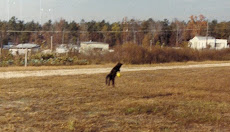
PHOTO ABOVE: Tac, my amazing cat. The yellow dot just in front of Tac is a tennis ball thrown from quite far away.
Back in the day, I was the proud poppa of an incredible cat named Tac. Tac (cat spelled backwards) was no ordinary cat. He enjoyed being petted, chased cows for fun, and fetched tennis balls!
PHOTO ABOVE: Tac fetching a tennis ball. Notice Tac and the shadow he casts. My judgment is that Tac was a full foot and a half in mid-air as he pounces upon the ball.
Tac would not only fetch the balls over and over again, but he'd chase them down as I'd throw them out onto a field 20, 30, 40 yards out!
PHOTO ABOVE: Tac enjoying the spoils of victory, next to a wax leaf Ligustrum. Wax leaf Ligustrum, scientific name - Ligustrum japonicum, is an evergreen shrub that is often used as a screening plant in Central Alabama and other areas with similar climate (this is a gardening blog, after all).
Posted by
themanfromearth
at
10:48 PM
1 comments
Labels: evergreen landscape plants, Rob's musings
Sunday, August 2, 2009
Spacing Indica Azaleas

PHOTO: G.G. Gerbing Azalea
The old tried and true Indica azalea is, for much of the South East (zone 7b, 8, and 9), especially from Birmingham to Mobile here in Alabama, a durable landscape plant that doesn’t seem to be losing much of its popularity as newly developed, heavily marketed plants find their way into the local nurseries. Indicas, with their large, showy blooms that appear in mid spring, are not only a popular natural area plant, but also finding a home as a mid sized foundation plant. Why not! They are evergreen, offer pleasant looking foliage, and if pruned properly, stay full of leaves from the ground up. Add to that the ability to grow in shade or quite sunny conditions, and you’ve got a real winner.
There are an array of Indica varieties to choose from. My experience is that some Indica azaleas, like Formosa and Pride of Mobile, are probably more suited to South Alabama than other varieties. The two Indica azaleas that I have used extensively and like the best are G.G.Gerbing (white) and George Tabor (shade of white, pink and lavender).
When laying out Indica azaleas to install, spacing is important. Decide how you want a planting to look in, say five years. A grouping of three gallon Indica Azalea, for instance, might look very satisfying with a two and a half to three foot spacing (from the center of the plant to the center of the next plant), but in five years, you will find it difficult to even walk between your plants to prune them. If a solid, hedge-like mass of azalea is what you want, and the challenge of pruning a closely spaced planting doesn’t scare you (it does me), then the decision to create a more mature looking landscape, initially, might have been worth it. 
PHOTO: George Tabor Azalea
A four and a half to five foot spacing (or even more), on the other hand, can be beneficial in a number of ways. A generous spacing will allow each azalea to grow with good air circulation. This means that the likelihood of your Indicas developing insect or disease problems is lessened. Maintaining a generously spaced grouping of azaleas will be easier, as well. While Indica azaleas can grow to well over ten feet tall and wide, keeping their size to about half of that is quite doable. With five foot or more spacing, your plants can be allowed to grow to a nice five foot tall by five foot wide size without needing drastic pruning to keep them there, and each azalea will have distinct form while the grouping, as a whole, will look full.
Of course, proper spacing is important with all plants. I can’t tell you how many times I’ve been called in to prune an over planted landscape. Some of these landscapes are less than five years old and it is nearly impossible to maintain them because of the improper spacing. There are times when the best option is to cut the plants to the ground and let them come back up as a new looking, bushy plants. This technique will then have to be repeated every few years. As an old fashioned hand pruner, to resort to that breaks my heart, but, I’m sure the landscape looked outstanding for the first couple of years.
Posted by
themanfromearth
at
7:25 AM
1 comments
Labels: evergreen landscape plants, landscape tip, pruning
Thursday, May 15, 2008
Vigorous Ground Cover = Asiatic Jasmine

Many descriptions come to mind when I think of Asiatic Jasmine...fast growing, pretty foliage, drought tolerant, tolerates sun and shade, and so on. While this plant may not be for everyone, especially if you are looking for plants that require "no attention", this little gem just might be a plant to work into some situations in your landscape. 
Asiatic jasmine is a ground cover that forms a thick carpet of shiny, evergreen leaves. It grows to a height of anywhere from 4" to 12+" as a ground cover, but can grow up a wall or down from a hanging basket or the top of a wall by as much as 10+'. Along a side walk or up against a house, the vine-like nature of this plant will require some maintenance. You may want to prune the jasmine to keep it from growing up the outside walls of your home and into the crevices of your windows, especially if they are within one foot of the ground. Along a sidewalk, an occasional trimming will keep things looking neat. Asiatic jasmine is tough, so it will tolerate heavy pruning, weed eating, or even pruning by mower (never thought I utter those words!).
One of the best things about Asiatic Jasmine is that it is quite pretty. A nice planting surrounding an accent stone, small specimen tree or garden art is quite a nice touch. This specific jasmine (scientific name Trachelospermum asiaticum) can bloom on long stems, but typically, you will not have flowering. It's just an elegant, yet strong plant (Zone 7-10) that can adapt to a variety of situations. You should give it a look for your landscape. It's certainly a plant I use from time to time in my exploits as a plants man.
Several varieties of Asiatic jasmine are available, including variegated forms and dwarf types.
A great plant for erosion control.
Posted by
themanfromearth
at
2:43 AM
0
comments
Labels: evergreen landscape plants
Tuesday, April 15, 2008
A brisk, sunny day in Vestavia, Alabama
A very nice couple and long time clients of mine allowed me to plant some of my favorite plants for them a few years back. Today, I stopped by to do some pruning and thought I'd take some pictures of a few of the plants that were looking especially nice. 
When it comes to pruning, I try to make my cuts in such a way as to promote the health and looks of the plant. I'm a big believer in hand pruning (with my trusty Felco pruners) as opposed to using shears, electric or otherwise, because you have so much more flexibility. If you are trying to get a natural looking pruning job when pruning Hydrangeas, for instance, shears are just not going to get the desired effect. Even with hollies such as these Needlepoint hollies in the picturee above, using hand pruners allows you to make cuts deeper inside the plant while still maintaining a manicured look, if that is the desired result as it was with these. And as always, I do my best to prune in such a way as to have plants such as these stay bushy all the way to the ground. This is what you want when pruning plants along your foundation or fence. Much of the same principles go for the pruning I did on the Green Robusta junipers, as well, except fot the exception of making deep cuts. With almost all conifers, such as cypresses, cedars, and junipers, you've got to be careful not to prune into wood that is too thick. They just don't respond well to heavy pruning.
OK, enough on pruning! Here are a few plants at this Vestavia home that I thought you might enjoy seeing:
Green lace-leaf Japanese maple. I planted this plant about 5 years ago. As I remember, it was a two gallon plant and was probably no more than 2' tall by 2' wide when I planted it. It is slow growing, but has managed to grow nearly 4' tall by 6' wide. Red varieties of Japanese maples get all the love at the local nurseries, but the green fellas have a lot to offer, as well, including outstanding fall color and a nice contrast to other plants such as these Parson junipers that are planted around it. 
Lady Banks rose is a thorn less rose that is well suited for trellises and training on walls. The garage door was such a big part of the front of this home that we felt something growing up and over it would help provide a soft effect. Lady Banks rose only blooms once a year, in the spring, but the flower show lasts for a good three or four weeks and the plant is evergreen. Another good reason to consider it. The homeowner has done a very good job of keeping it growing over the garage doors (in this case, with masonry nails and ties) and it requires some pruning of limbs when they hang too low. Lady Banks rose is available in yellow and white blooming forms. 
And finally, the ol' standby for what to use as a small tree in a small yard has to be Bloodgood Japanese maple. When I planted this tree five years ago, it was probably about four or five feet tall with limited branching. One key to the success of any tree planted in a turf situation is to create a mulch ring or mulched natural area around the tree which eliminates mower or weed trimmer damage. As far as pruning goes, I occasionally remove lower branches so mowing isn't a hassle and to allow light to the grass below. There are lots and lots of worthy upright red Japanese maple varieties to chose from and Bloodgood is certainly the grand daddy of them all and continues to be a great choice for the landscape. 
Posted by
themanfromearth
at
4:29 PM
2
comments
Labels: evergreen landscape plants, pruning, trees
Saturday, March 29, 2008
Resurrection fern

During my recent working trip to Dadeville, I would drive to the local hardware store or corner gas station from time to time. By the way, how great are those old time hardware stores! My little forays to pick up mortar mix or a Diet Mountain Dew would always direct me by a little house off the road with a giant oak tree smack dab in the middle of the front yard. Growing all over its massive branches was this tiny fern...clusters of them, happy and green, a sight to be seen. 
Of course, Resurrection fern is not an oddity in the South (and it does grow as far North as Delaware). If you are out and about and looking for it, you'll probably see the little evergreen fern pretty quickly. Every now and then, you'll likely spot an old Oak tree that is pert near full of them, except for the sunniest parts of the tree. It's really a pretty sight.
Resurrection fern is an epiphyte (air plant) that grows along the narrow cracks and furrows of its host tree's bark, getting nutrients that collect on the outer surface of bark. It is not a parasite, like Mistletoe, and it does not harm or damage the tree it is growing on.
When dry, the resurrection fern is gray, scaly and curled up in a wad, but when moisture returns, the fronds resurrect becoming soft and green and unfurling to regain its original shape. 
If you don't have resurrection fern growning on trees in your yard, you can grab a starter plant from a fallen branch in the woods and squeeze several inches of the fern's rhizome into the furrows of the bark of its new host. Keep it moistened from time to time until it takes hold and begins growing on its own.
ps...thank you, floridata.com for the lovely pics
Posted by
themanfromearth
at
8:28 AM
0
comments
Labels: evergreen landscape plants
Tuesday, March 18, 2008
Are you considering planting Indian Hawthorne?

PHOTO: Snow White Indian Hawthorne (Raphiolepsis umbellata ‘Snow White’) - White, small clusters; plant grows to about 3.5’ by 3.5’.
My first blog request! And a dandy it is ….. Indian hawthorne (genus Raphiolepsis). Most Indian hawthorne are compact (although I’ve seen some Hawthorns approaching over 20’ tall), spring blooming with fragrance (showy in white or pink tones), evergreen shrub.
My subjective observations on the plant: This plant has slowly grown on me over the years. At first, there was a lack of availability in regard to numbers of and variations of Indian hawthorne varieties. Another thing I noticed that kept me from being keen on this plant is that there seemed to be a lot of under performing hawthornes out there. It has since occurred to me that Indian hawthorne is not one of those plants you dig a skimpy hole for and watch it thrive. You can do that with some easier to grow plants, like dwarf yaupon and Chinese holly, but not so much with Indian hawthorne. For instance, if I were going to plant Indian hawthorne in my front foundation planting bed, I’d probably think about adding some fresh soil (bagged or bulk) to the existing soil. The reasons for this extra soil are: (1) to create a “raised” environment (the grade sloping away from the house and the top of the plant root ball being higher than the surrounding soil) (2) to add organic material to the soil, which you will work into the existing dirt in your bed. Trust me, your hawthorne plants will appreciate the attention. Another reason I believe I've noticed so many poor looking Indian Hawthorns, in the past, is that many of them had leaf spot, and possibly, fire blight. Now, there are Raphiolepsis varieties that are disease resistant, making Indian hawthorne a much more viable choice for your garden.
PHOTO: Indian Princess Indian hawthorne (Raphiolepsis indica ‘Monto’) - Pink flower clusters that fade to white for a two color effect; plant grows about 3’ tall by about 5’ wide.
But wait! I’m getting ahead of myself, here. Will Indian hawthorne grow in the conditions I have awaiting it? Here is the recipe for good Indian hawthorne behavior:
A. Full sun to part shade - Indian Hawthorns appear to do best in full sun, although I have seen some that seemed to get too much sun, perhaps a hot afternoon sun reflecting off a sidewalk or driveway contributing to that bleached out or scorched look I’ve noticed a few times. I would say, in most instances, that 4+ hours of sunlight should be enough to make your plantings happy. Note that there is some discrepancy among nurseries on how much sun they say Raphiolepsis needs, with some stating the plant will grow in full shade. I just haven’t seen that happening and I don’t agree. Sorry big, huge wholesale nursery in South Alabama whose name I won’t mention :-)
B. Well drained, organically rich soil - thus the addition of soil to your planting bed.
C. Living within zone 7 thru 10 - This depends on variety, but you are generally safe if you live within these zone parameters. Here in North Shelby County, we are in the southern part of zone 7, so Indian hawthorne should be able to survive most anything Old Man Winter has to dish out.
D. Planting the variety that makes since for you. There are lots of species and varieties of Raphiolepsis, so I suggest you read the label carefully when buying an Indian hawthorne. Look for a type that is disease resistant, since Indian hawthornes can get leaf spot. Here are a few disease resistant varieties - Olivia, Gulf Green, Indian Princess, Snow White, Majestic Beauty, Janice, Eleanor Tabor, Jack Evans and Rosalinda. . Check and make sure the hardiness rating includes zone 7 (assuming you live in the Birmingham area) and see what size the plant you are considering will grow to. If you chose a smaller growing, compact variety, you’ll likely have little or no pruning to do for years to come. 
PHOTO: Majestic Beauty Indian hawthorne (Raphiolepsis X ‘Montic’) - Pink, star shaped flowers in huge clusters; plant can grow to 15’+ tall by 12’+ wide.
PHOTO: Eleanor Tabor Indian hawthorne (Raphiolepsis umbellata ‘Conor’) - Pink, small clusters; plant grows to about 3.5’ by 3.5’.
Posted by
themanfromearth
at
11:06 PM
88
comments
Saturday, February 9, 2008
Wonder Plant!


This is Winter Jasmine that I planted on a steep embankment in the Crestwood area of Birmingham. I also used landscape fabric which contributed to the clean, weed free environment the jasmine is growing in.
I should temper my enthusiasm, lest I become remininscent of magazine ads proclaiming "watch it grow, it's just that fast" or "a few small pots will become an orchard in mere months!" BUT! I am impressed with this plant - Winter Jasmine. It's a mostly evergreen, medium sized shrub that has cute yellow blooms in the winter (yes! the winter) and will tolerate a variety of conditions. Given its tendency to root where ever a stem touches the ground, it's a great plant for difficult slopes, yet despite the tendency to root, it will not quickly become an intruder on your other plants. Winter Jasmine is very cold hardy for our area and easy to grow. No, it's not super showy in bloom, like a crepe myrtle, for example, but I have seen quite a few very nice stands in bloom. I'd definitely suggest using a grouping to make an impact. Note: Be sure to distinguish Winter Jasmine (Jasminun nudiflorum) from Showy Jasmine (Jasminun floridum) or Primrose Jasmine (Jasminum mesnyi). While those are nice plants, they grow larger than Winter Jasmine and are not as cold hardy.

In conclusion, I recommend Winter Jasmine because they:
1. are easy to grow
2. blooms when almost nothing else is
3. are cold hardy for the Central Alabama area
4. are good for erosion control
5. can be found in a one gallon size, which is good for the pocket book
6. grow moderately fast, but not to a fault
7. perform well in full sun or part shade
8. can put on quite a show when in bloom
Posted by
themanfromearth
at
11:06 PM
0
comments
Labels: evergreen landscape plants
Wednesday, November 14, 2007
Yaupon Holly - Ilex vomitoria
Why am I blogging on Yaupon Holly? Could it be because I have one in my front yard? Perhaps I'm blogging on it because it is a fine evergreen plant that works as a screen or a specimen when limbed up. Don't forget that it is native to Alabama and other nearby states and has a fine show of red berries every fall through to spring! Nope....I like it's scientific name and the story behind it - Ilex vomitoria...
Yaupon (Ilex vomitoria) was a sacred shrub to American Indians throughout the Gulf Coast region, where it grows. The leaves contain caffeine and, when used in small amounts, can be made into a mildly stimulating drink. The local American Indians, however, used it in great amounts to induce vomiting (thus the scientific name, Ilex vomitoria) during their rituals. Europeans, observing these purging ceremonies, gave the plant its species name.
Posted by
themanfromearth
at
5:07 PM
3
comments
Labels: evergreen landscape plants
Sunday, November 4, 2007
Camellia season is here!

Camellia appreciaters everywhere are probably aware of the notion that there are two main types of this cool weather bloomer - Camellia japonica and Camellia sasanqua. While the distinction between these two types of camellia is important, there are new introductions resulting from hybridization between different species other than japonica and sasanqua. There are 80 or so species of Camellia, all of them native to areas in Asia such as Japan, Korea, and Taiwan.
Posted by
themanfromearth
at
7:21 AM
0
comments
Labels: evergreen landscape plants
Thursday, October 25, 2007
Speaking of Mahonia…

What’s not to like? Well, let’s get the negatives out of the way. The biggest complaints regarding most Mahonias (there are several species planted in landscapes) is that they have thorns and that they are leggy.
The thorns are something we can’t do anything about, except that there are some species with thorns that aren’t as prickly as others. Also, just remember that when using Mahonia, don’t plant it on either side of a narrow passage way. The legginess issue is easily rectified by pruning out older taller canes down to within six to twelve inches of the ground. The Mahonia will rejuvenate and stay bushy from bottom to top.
What’s to like? Let’s start with the course texture and exotic appeal. Mahonia has a one of a kind form and texture. It’s unmistakable! Used in a mass planting, it takes on a dominant role in your garden. What else? Mahonia is a great plant for shady areas of your yard. You know how hard it is to find plants for that particularly shady spot….why not give Mahonia a try. Mahonia will also do well in sunny spots, but the color of the leaves really stands out in shade to part shade. Lastly, don’t forget the blooms and fruit. Mahonias bloom early in the spring with clusters of yellow spikes containing tiny flowers. It’s quite showy. After the flowering, look forward to very pretty powder blue to deep dark purlple berries.
One of the lesser known positive traits of Mahonia is that it is extremely drought resistant. Plant it and water it through the first year and then you can pretty much forget about it. Along with Nandina domestica, it is a great plant to install under extra large eaves or awnings.
Species and varieties of note:
Mahonia japonica ‘Bealei’ - the most commonly planted Mahonia. Grows to 10’; maintainable at 4’-5’. Zones 5-8. This particular plant is very easy to grow.
Mahonia aquifolium - Finer texture and requires a little more sun than M. japonica. Grows to 6’; maintainable at 3’. This species is more irregular and a little harder to grow than M. japonica. Still worthy of use, especially where an oriental effect would be desired.
Mahonia fortunie - A different looking Mahonia. It has narrow, fern-like leaves and a more compact habit of growth. Very attractive and less nasty thorns. The negative is that the species here is rated zones 8 and 9. In the Birmingham area, I’d only recommend it for use in protected situations like a courtyard.
Mahonia repens - creeping Mahonia… hard to find, but an interesting choice for your garden. This plant is rated zone 8 - 5, so hardiness shouldn’t be an issue. This mahonia will only grow 1.5’ - 2’, but will spread 3’ - 4’. It needs a little sun, but not too much and makes a great large scale ground cover or a small shrub grouping. If you can find it, give it a try.
All the Mahonias I’ve mentioned have yellow flowers and are evergreen.
Click on "Mahonia" to the left to view a short video of a Mahonia.
Happy Mahonia planting!!!
Posted by
themanfromearth
at
9:37 AM
0
comments
Labels: evergreen landscape plants