When ever I talk to a client about a landscape project, one of the first things I mention (if the client hasn't) is, "will there be a need for hardscaping?". My definition of hardscaping is any non-movable element in the garden. Of course, plants and turf grow, so they are considered softscaping.
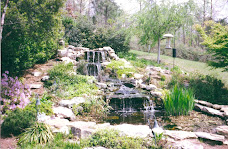
PHOTO RIGHT: Pondless waterfall
Hardscaping would include walls, walkways, ponds, bird baths, driveways, garden art, steps, etc. The reason I ask about hardscaping is because it's always a good idea to do that phase of the landscaping first to make the entire project go more smoothly.
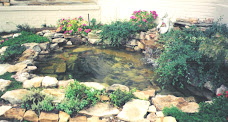
PHOTO RIGHT: Wall with waterfall incorporated.
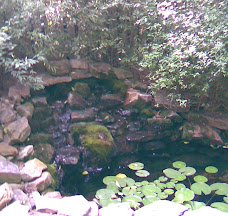
These photos and video are of a project I've been working on. I'm done with the major hardscaping and have done very little softscaping, so the results look a little unfinished until I get some fall plantings, possibly a few well placed mini-boulders, and a stone bench installed.
PHOTO BELOW: Stepping stones are considered hardscaping.
ABOVE: Video of pondless waterfall.
Thursday, September 25, 2008
Consider your hardscaping before going soft.

Monday, September 15, 2008
Informal steps
Sometimes you have a pile of mismatched stone, a hill, and a need. While that may not be an occurrence that you have ever been faced with, it is actually one I encounter at least once a year. 
A few years back, I took some irregular natural stone and various pieces of flagstone and put together this set of informal steps. It's not always the way to go, but in some instances, a set of steps that mildly twist up an incline (especially when surrounding area is planted with interesting flora) can be a positive addition to the landscape.
Thursday, September 4, 2008
A Beauty of a Berry
 PHOTO ABOVE-Callicarpa americana
I have several memories of specific plants that go back to before I actually thought plants and nature in general would become a big part of my livelihood. One of those memories goes back to when I was a young teen. I remember spending some time at Logan Martin Lake, near Pell City, AL, with my family on the weekends. I enjoyed walking the woods that stretched above the banks of the lake, checking out all manner of interesting flora and critters. American Beautyberry is a plant that I remember growing in those woodlands. How could you not notice those striking purple berries in late summer or early fall? There simply isn't another native plant quite like it. I find beautyberry to be a plant that should find a home in many yards, as well. The plant is native throughout the Southeast and growing it here in Alabama shouldn't be a problem. I have found that growing Callicarpa (the genus for beautyberry) is relatively easy. It isn't particularly finicky when it comes to soil type, sun exposure, or moisture requirements. If you happen to live South of Birmingham, and especially if you live South of Montgomery and into Florida, you may just find your beautyberry to be quite the spectacle. While vacationing in the panhandle of Florida, several years back, I noticed several native beautyberry growing magnificently. I suspect beautyberry enjoys the warmer surroundings, even though it is listed as a Zone 5 plant.
While American beautyberry (scientific name, Callicarpa americana, also known as purple beautyberry) is probably the most familiar of Callicarpa species in these parts, there are other species to note:
PHOTO RIGHT-Callicarpa dichotima - a more compact plant than Callicarpa americana and is known to produce more berries, as well, but that may be more due to it's compact nature.
PHOTO LEFT-Callicarpa japonica 'Leucocarpa' - often described as "rare", this plant does have an unusual trait; it's white berries.
Most beautyberries grow to a height of around 4' to 6'. They are deciduous and they bloom around mid June to mid July. The blooms are not particularly ornate, but the plant makes up for its lack of flower power with plentiful and colorful berry production. Beautyberry will bloom and produce berries on new wood, so I would encourage you to cut any plants in your yard each spring. I've just touched on two or three Callicarpa species, but there are several more and dozens of varieties.
Monday, August 25, 2008
Conserving Water .... a couple of ideas.

UPDATE:
A few days ago I met with a very nice couple that I've done work for in the past. I thought it was really quite neat to see that their daughter had hand painted a rain barrel at the front corner of their home to help irrigate some plants in their back yard. I think she did a great job, don't you?
ORIGINAL POST:
Our cities grow and the demand for water increases. Many people love their plants. They are like friends to them. During the last few years, there have been instances where city governments have placed restrictions on outdoor watering. When outdoor watering is restricted, we are making it hard for our plant friends to be all they can be. One way to help is homemade water conservation.
Water Barrels - Connect to your roof gutters and direct year-round rainfall into these durable collection barrels. These barrels range in price from $60 - $150.
A link to "How to make your own water barrel:
http://www.bayteccontainers.com/howtomaraba.html
Here are a few more ideas that might help with water conservation:
You can do many things to capture rainfall at your site:
-Create depressions around trees and line them with rocks or mulch to retain moisture.
-If you are designing a new home site for water harvesting, arrange brick or flagstone paving to direct water to plants.
-Dig furrows and channels to direct water to a garden.
-Make sure your gutters and downspouts are free of trash, dirt and leaves.
Sunday, August 17, 2008
Stone mailbox


VIDEO ABOVE
I really enjoyed doing this job. It was my first stone mailbox and my clients felt comfortable with me doing the work. Just about the entire time I was working on this project, the homeowners were out of town. I was told that the lady of the house closed her eyes and she and her husband drove up. "How does it look?", she asked her husband. All is well. The homeowners are pleased and, of course, that is very important to me.
Wednesday, August 13, 2008
A fall wall?
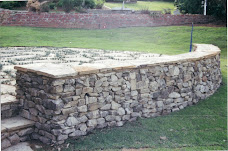
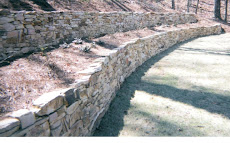
Do you feel the hint of fall in the air? I do! At least, I think I do. I hope it's not a mirage. As the summer winds down and footballs begin to penetrate the air, I find myself in the middle of a couple of projects. One is a stone mailbox and the other is a backyard stack wall. Here are some pictures of the wall I'm building. I'll be sure to provide photos of the finished project when I'm done. Photos of the mailbox are forthcoming.  PHOTO LEFT: Here's part of the wall I'm working on, including some of the tools of my trade (shovel, hand mattock, rubber mallet, small sledge hammer, rock hammer...level and chisel missing in photo).
 PHOTO LEFT: One aspect of putting this wall together was removing the artificial segmented stones and redesigning the wall. The stone used is a mixture of various types of stone already on the property.
Wednesday, August 6, 2008
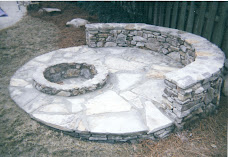
Circular patio with fire pit and sitting wall
 Me and my trusty pick-up found our way to Trussville, recently. I met a very nice family there that was interested in having a round patio with a firepit and sitting wall. They explained to me that the round shape of a patio would contribute a calming effect to those who used it. I have to admit, I do feel a calm pass over me when I sit on that patio, now that it is completed. The line of a circle is so simple, yet beautiful, you know. It's no wonder it can bring about serenity and convergence.
VIDEO: Circle Patio