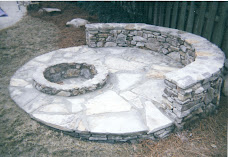
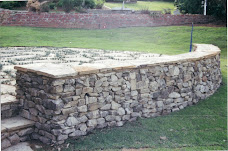
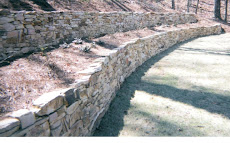
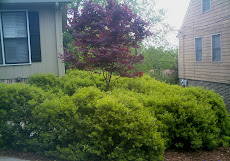
The last couple of weeks or so, in between rain and cold (for Alabama), I've been in Homewood working on the installation of a parking pad, flagstone walk, and a stepping stone path.
The objective, initially was to find a spot for a car new to the family. Yes, a teenage driver (insert Bates Motel music)!!!
We decided to surface the pad with an 8910 gravel which was chosen because of the particular quarry it came from. This gravel has a slightly tan color and is not as stark as the typical gravel you buy from suppliers. Also, using 8910 gravel, which will pack down and offer an excellent surface for parking, is economical, and at the same time, attractive and functional.
The parking pad was bordered, on the lawn side, with a stone soldier course. Those stone, most of which are exposed 3 inches above the grass line, have nine plus inches buried and surrounded with cement and mortar. Careful attention was used in selecting the soldier course stone so that, one, the colors matched with the walkway, and two, that the length and thickness of the stone fell in place with the over all scale of the entire project.
The flagstone walkway was installed using a combination of stepping stones that were previously used for traffic from the drive to the front door and from stones the homeowner had left over from previous work on the house. Using the two different types of stone actually made for an interesting combination that worked well together.
The stepping stone path was chosen to provide access from the pad to the front door. As usual, I tried to steer away from straight lines, trying to make the pathway seem more "organic".  PHOTO: Crimson Queen Japanese maple
Finally, a planting bed was created at the head of the parking pad to help direct foot traffic and help soften the over all project. The homeowner has already bought a 'Crimson Queen' Japanese Maple to plant in the bed. It should really enhance the entire job.p
Thursday, December 11, 2008
Parking Pad/Pathway Job Walk Through

Friday, November 21, 2008
Website review: monrovia.com
If you are like me, you have an appetite for good sources of information on plants. What is their hardiness rating? What new varieties are available for purchase? Hey, what does it look like!? These and many more questions come to mind. One of the better Internet sites I've found to answer these questions and more is monrovia.com.
Monrovia is a wholesale container nursery that was started in 1926, by Harry Rosedale. The first nursery was located in California, although, now they have nurseries as far east as Georgia. I can remember back in my early nursery days in the late 70's that Monrovia was synonymous with quality and innovation, and they still are today.
So, on to the site! The web site is divided into four sections, Inspiration, Design, Learn and Community.
The Inspiration section has interesting features that include a "style quiz" that helps to give you a sense of what type of garden you'd really enjoy as your personal outdoor environment.
In the Design section of the website, you'll find tips on landscape design and a helpful "how-to video". The "how-to video" was well done and relevant to the season of the year.
Learn is broken down into six categories: soil story, plant catalog, new plants, gardening basics, zones and resources. Lots of good info here, particularly the resources area where you'll find a bunch of interesting links, but the main reason for visiting monrovia.com is the plant catalog and new plants portion of the Learn section of the website. Monrovia's catalog is vast and detailed. If you have a particular plant in mind that you want to get information on, you can simply access that info from the search engine at the top left of the home page, but it you are searching for advice on what might work in a specific situation, then use the searches in the plant catalog and new plant section of Learn. There are lots of ways to narrow your search using those two engines, but I'll warn you in advance not to put too many criteria in place when performing the search or you'll get zero matches. Once you find a plant, you are rewarded with fine photographs of the plant, plus info on light needs, mature size, etc. 
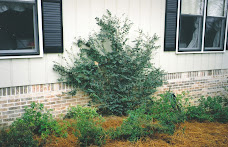
PHOTO: Just one of hundreds of photos you'll find at monrovia.com. This one is Viburnum Opulus 'Aureum'
Community gives you an opportunity to develop a personal profile and participate in online forums, read blogs, and subscribe to a newsletter.
In conclusion, monrovia.com is a fun site with a lot of interesting and helpful places to visit in the site. It's plant search engine is a good way for you to get suggestions on what to plant in a specific spot in your yard and if you have a specific plant in mind, you can get some good info on that plant and perhaps find some closely related new varieties, as well. Rob's 5 star rating guide for monrovia.com: ****1/2 (4.5 stars)
Wednesday, November 5, 2008
When is it a good time to plant shrubs and trees?

This is a question I get asked from time to time and like many in my profession, I have my opinions. The criteria I am going to use for ranking months to plant woody shrubs and trees is survivability. Planting a large tree in scorching July heat, for instance, could be so stressful that a tree could perish with less than optimum care. So here are the rankings, from worst to best:
#11 and #12 - July and August - I wouldn’t suggest planting woody shrubs or trees in these two months. July is the hottest month in Central Alabama with an average high of 91 degrees; however, it can be a wet month, averaging a little over 5” of precipitation a month. August might be a little more tempting of a month due to its closer proximity to fall, but with an average high temperature of 90 degrees and it being the second driest month, with less than 3.5” of rain, on average, it is just as unsafe a month to plant in as July is.
#10 - June - Spring has sprung and summer is gaining momentum. Don’t get fooled by a few pretty days. With average high temps of 88 degrees and an average monthly rainfall of 3.78 inches (third worst month), June offers little upside for planting things like forsythia, maple and other shrubs and trees.
PHOTO: Red Sunset maple
#8 and #9 - May and September - Neither is an awesome month to plant in, yet neither is off limits. If the subsequent care (especially watering) of the plants being considered for installation is going to be good, I will plant them. Both of these months average over 80 degrees. September is a slightly drier month than May, but September is closer to fall (a very planting friendly season), so it’s a draw between these two.
#7 - April - I know. I know. That is a month when nurseries are bursting with folks looking for things to plant. Well, there are two things to consider. One, those people aren’t well informed….just kidding, haha. One, many of those people are looking for annuals and perennials to plant and my list is for woody shrubs and trees. And two, April is just two and a half months removed from the summer season. I’m not saying this is a bad month to plant in; it is a good month to plant in, just not the best.
#6 - March - March is a very fine time to plant. With an average high temp of 66 degrees and the wettest month of the year, March is plant friendly. But there are even better months ahead!
#4 & #5 - December and January - I love planting in December and January. These months would be ranked higher if not for the disclaimer I need to provide for them. Disclaimer: I would "consider" excluding plants with a zone hardiness rating of 8 or higher (some examples would be oleander ,pittosporum, or some varieties of gardenia), because of their susceptibility to cold damage. Don't let the disclaimer scare you off, though. Put on your long johns, grab a shovel, and plant your sweet shrub and dogwood, knowing they are loving you for caring enough to find them a new permanent home at the right time of the year.
PHOTO: Sweet shrub (fragrant, deciduous flowering shrub)
#3 - October - Why isn’t October #1 or #2? Well, it gets edged out because it can still be rather warm in October and it’s typically a dry month (the driest on average of all the months, averaging just 3.23” of rain). Still, fall has just begun and you’ve got all of this great root growing season ahead of you (fall and spring are the seasons when roots grow the most), plus the mild Alabama winter and then spring greet us before the harsh summer whacks us upside the head. October is a winning month for planting, for sure.
#2 - February - This is a great time to plant. Root growth is occurring. Deciduous plants haven’t leafed out, yet, reducing the amount of transpiration (water loss), which can stress a plant out. Yes, February is a wonderful time of the year for getting in your hydrangeas, magnolias, and other such flora. If not for the fact that February is less than four months away from summer, it would probably be #1. But forget that! It’s a totally awesome month to dig in. Can you dig it?
Ta,,,ta,ta,ta,ta,ta,taaaaaa!
#1 - November - This is the best of all the months to plant in, with February and October following close behind. November features an average high temperature of 65 degrees and is in the top half of rain producing months. The root growth of the plants you are planting will be through the roof and you have plenty of time before mean ol’ summer arrives. 
PHOTO: Grancy gray beard (small tree or large shrub)
If you notice, the three worst months to plant in are in the summer. Heat does not blend in well with planting shrubs and trees. It can be done, but as you see, there are better times of the year. I really don’t have a problem with any of the other nine months for planting, but some are just a little better or a little worse than the other. It’s Novermber, now, so if you’ve got a little snowball viburnum or Grancy gray beard that you’re think of planting, there couldn’t be a better time than now!
Friday, October 10, 2008
Transform a ho-hum bed into something more
Have you ever noticed how a flower bed can start to lose its appeal? Grass and weeds begin to creep in and take up residence with the plants. Some of the plants just aren't performing as well as they could. Oh, woe is the gardener that confronts such a situation with little time and even less money (the DOW was down again) to do something about it. 
Recently, I encountered just such a situation at a very nice couple's home in Homewood. The bed on the back side of their home was divided into two or three sections. Some of the beds had loosely arranged rock borders, where the rock was basically sitting on top of the ground, and other beds had no rock border or delineation at all. Bermuda grass, the scurge of flower lovers, had found its way into much of the garden space, as well.
The recipe to upgrade this garden didn't take much time or expense. 
The formula for this situation:
1. With a can of spray paint, I played around with some curved lines for the bed outline, letting some of the plants that were already planted dictate how far out from the brick the beds would extend.
2. Once the outline was determined, weeds and Bermuda grass were sprayed.
3. Using the stone that was already there and adding a little bit more (from my own personal pile!), the border was installed. Nothing fancy, here. Much of the stone was dug up over the last couple of years, right there on the property. Tip: When installing a stone border, try standing the stone on edge, buried a few inches and then tamped in, to get more mileage out of your resources.
4. After installing the border, a soil mix was added to the bed. A few plants were raised so not to be planted too deeply and ferns, hosta, peonies, and few other fun flora were divided and replanted (dividing plants, a great way to take up garden space).
5. Where appropriate, landscape fabric was installed to keep weed re-emergence to a minimum. And finally, mulch was applied. 
To make this little project work, three things were essential.
1. A design that the client was happy with.
2. Proper installation techniques (in the case of this project, that would be plants and stone).
3. Maintenance (don't let weeds go unattended, mostly).
These three components are the keys to any successful landscape project. DESIGN, INSTALLATION and MAINTENANCE.
Thursday, September 25, 2008
Consider your hardscaping before going soft.

When ever I talk to a client about a landscape project, one of the first things I mention (if the client hasn't) is, "will there be a need for hardscaping?". My definition of hardscaping is any non-movable element in the garden. Of course, plants and turf grow, so they are considered softscaping.
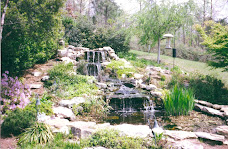
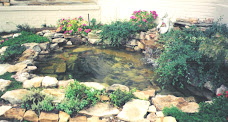
PHOTO RIGHT: Pondless waterfall
Hardscaping would include walls, walkways, ponds, bird baths, driveways, garden art, steps, etc. The reason I ask about hardscaping is because it's always a good idea to do that phase of the landscaping first to make the entire project go more smoothly.
PHOTO RIGHT: Wall with waterfall incorporated.
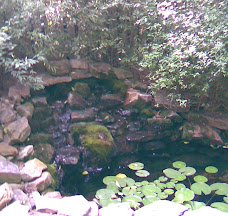
These photos and video are of a project I've been working on. I'm done with the major hardscaping and have done very little softscaping, so the results look a little unfinished until I get some fall plantings, possibly a few well placed mini-boulders, and a stone bench installed.
PHOTO BELOW: Stepping stones are considered hardscaping.
ABOVE: Video of pondless waterfall.
Monday, September 15, 2008
Informal steps
Sometimes you have a pile of mismatched stone, a hill, and a need. While that may not be an occurrence that you have ever been faced with, it is actually one I encounter at least once a year. 
A few years back, I took some irregular natural stone and various pieces of flagstone and put together this set of informal steps. It's not always the way to go, but in some instances, a set of steps that mildly twist up an incline (especially when surrounding area is planted with interesting flora) can be a positive addition to the landscape.
Thursday, September 4, 2008
A Beauty of a Berry
 PHOTO ABOVE-Callicarpa americana
I have several memories of specific plants that go back to before I actually thought plants and nature in general would become a big part of my livelihood. One of those memories goes back to when I was a young teen. I remember spending some time at Logan Martin Lake, near Pell City, AL, with my family on the weekends. I enjoyed walking the woods that stretched above the banks of the lake, checking out all manner of interesting flora and critters. American Beautyberry is a plant that I remember growing in those woodlands. How could you not notice those striking purple berries in late summer or early fall? There simply isn't another native plant quite like it. I find beautyberry to be a plant that should find a home in many yards, as well. The plant is native throughout the Southeast and growing it here in Alabama shouldn't be a problem. I have found that growing Callicarpa (the genus for beautyberry) is relatively easy. It isn't particularly finicky when it comes to soil type, sun exposure, or moisture requirements. If you happen to live South of Birmingham, and especially if you live South of Montgomery and into Florida, you may just find your beautyberry to be quite the spectacle. While vacationing in the panhandle of Florida, several years back, I noticed several native beautyberry growing magnificently. I suspect beautyberry enjoys the warmer surroundings, even though it is listed as a Zone 5 plant.
While American beautyberry (scientific name, Callicarpa americana, also known as purple beautyberry) is probably the most familiar of Callicarpa species in these parts, there are other species to note:
PHOTO RIGHT-Callicarpa dichotima - a more compact plant than Callicarpa americana and is known to produce more berries, as well, but that may be more due to it's compact nature.
PHOTO LEFT-Callicarpa japonica 'Leucocarpa' - often described as "rare", this plant does have an unusual trait; it's white berries.
Most beautyberries grow to a height of around 4' to 6'. They are deciduous and they bloom around mid June to mid July. The blooms are not particularly ornate, but the plant makes up for its lack of flower power with plentiful and colorful berry production. Beautyberry will bloom and produce berries on new wood, so I would encourage you to cut any plants in your yard each spring. I've just touched on two or three Callicarpa species, but there are several more and dozens of varieties.