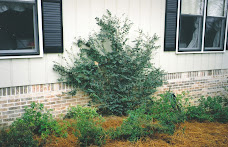
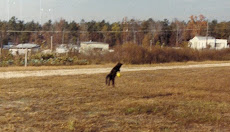
PHOTO ABOVE: Tac, my amazing cat. The yellow dot just in front of Tac is a tennis ball thrown from quite far away.
Back in the day, I was the proud poppa of an incredible cat named Tac. Tac (cat spelled backwards) was no ordinary cat. He enjoyed being petted, chased cows for fun, and fetched tennis balls!
PHOTO ABOVE: Tac fetching a tennis ball. Notice Tac and the shadow he casts. My judgment is that Tac was a full foot and a half in mid-air as he pounces upon the ball.
Tac would not only fetch the balls over and over again, but he'd chase them down as I'd throw them out onto a field 20, 30, 40 yards out!
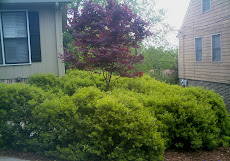
PHOTO ABOVE: Tac enjoying the spoils of victory, next to a wax leaf Ligustrum. Wax leaf Ligustrum, scientific name - Ligustrum japonicum, is an evergreen shrub that is often used as a screening plant in Central Alabama and other areas with similar climate (this is a gardening blog, after all).
Monday, February 22, 2010
Amazing cat has dog-like tendencies!

Saturday, January 30, 2010
The little pump that could.
I recently got a call from a lady I had built a water feature for about 8 years ago. She was concerned over a noise coming from her pump. At one point I asked her how old this pump was. She told me that it was the original. Wow! Most pond pumps have a lifetime of around 3 years, so this was definitely a rarity. She told me, during our phone conversation, that she had unplugged the pump, which is what I would have advised her to do.
Today, I went by to check on things. Upon plugging the pump back in, the noise was gone and this eight year old pump had new life. Admittedly, the pump could stop tomorrow and it would be five years over due, but this is quite amazing.
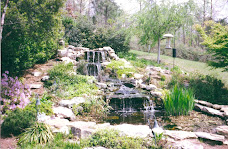
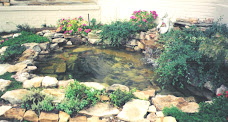
On with the project! The home here has a small back yard. The view from the rear of the home looks right out onto the water feature, where there are also some tasteful plantings. The water feature includes a 4' x 6' main pool with a water course that is about 2.5' tall. The flagstone coping around the main pool gives the project a sort of old world, yet elegant appeal; and the water recalls the peacefulness of nature. Beyond the pond, some small, curved flagstone landings and small stepping stones help to create a cohesiveness with the rest of the yard.
If this video is not available, try this link.
Note: I installed the project, but was the recipient of a very thoughtful design by a very nice lady that lives in the area.
Saturday, January 2, 2010
Happy New Year!


Nature, whether it is enjoyed in a forest, on a mountain range, or among the flowers in your own backyard garden, gives a fresh perspective on life. Any specific moment spent in the amazing natural environments of this earth reveal secrets that are different for each and every one of us. These secrets soothe us and provide nourishment for our souls. I hope to take more time, this new year, to realize these moments with more appreciation and I hope everyone has a wonderful new year!
Friday, December 25, 2009
Merry Christmas and happy holidays to one and all!
As we watch 2009 roll by and 2010 getting ushered in, I thought I'd post a video of some music, befitting of the season, for your enjoyment. Thanks goes out to my friends, Shawn, Bud, and Roy, for whom it is always an honor to share music with. Click here to watch the video.
Sunday, November 15, 2009
The 2009 Harmony Landscapes Alabama Native Tree Fall Color Awards
Most folks I know tell me that Fall is their favorite season of the year. I’m in complete agreement. If you ever happened along an episode of Family Feud and the question was, “reasons people say Fall is their favorite season”, the answers would probably read something like this: “Out of one hundred people surveyed! 2 people said –the school year starts, 8 said – Halloween & Thanksgiving, 32 said- football season, and 58 said - leaves turning” [host then smooches the contestants]. With the colorful fall foliage being so popular, I've decided to present certain trees with awards.
As far as criterion to receive my award is concerned, it’s just this: all trees must be native to our part of the state. So, for example, dogwoods are in and crape myrtles are out, even though most crape myrtles offer excellent fall color. Figuring out what constitutes a native tree is an interesting question, but for now, we'll just say it's got to be a tree you might see while strolling through the Alabama woodlands.
So, on to the awards!
Best Early Color – Dogwood (Cornus florida) – dogwoods are one of the first trees to turn and if they managed to get through the spring without too much leaf spot damage, the dark red colors (especially if highlighted with some of their bright red berries) is a sure sign that Fall is here. Another plus with dogwood is their ability to hold on to leaves and give an extended show. Runner up: black gum (Nyssa sylvatica)
PHOTO RIGHT: Dogwood 
Best Red Overall – Red Southern Maple (Acer rubrum) – I’m sort of partial to the non-hybrid, old fashioned, Southern red maple. There is a little more variation in color, with reds usually dominating, but Southern red maple can also give us beautiful oranges and yellows. Runner up: Sourwood (Oxydendrum arboretum)
PHOTO BELOW: Southern Red Maple  Best Orange Overall – Southern or Florida sugar maple (Acer barbatum) – I don’t recall seeing this tree in local nurseries, although, I could be wrong. Florida sugar maple is a nice change of pace from the oft used Southern red maple, and it’s more suited to our climate than regular sugar maple (Acer saccharinum). Orange fall color isn't so easily obtained, so an effort to get one of these trees in your yard may have me saying to you, one day in the future, “orange you glad you planted a Florida maple?” Runner up: American Smoke Tree (Cotinus obovatus)
PHOTO LEFT: Florida Sugar Maple .jpg)
Best Yellow Overall – Pignut Hickory (Carya glabra) – Deep banana yellow is how I’d describe its Fall color. This big tree makes an impressive statement. Pignut hickory is rarely found for sale in nurseries, so if you have one in your yard, consider keeping for its bold autumn statement . Runner up: Tulip poplar (Lirodendron tulipifera)
PHOTO ABOVE: Pignut Hickory
Best Late Color - Red Oak (Quercus rubra) - So many oaks to chose from! But red oak is definitely one of the better oaks for superior fall color. You'll have to wait, however, as the deep red colors don't show themselves until well into November. Runner up: A testament to it's long show of fall color- Dogwood (Cornus florida)
PHOTO RIGHT: Red Oak
Special award:
Best Fall color from a tree no one wants – Sweet gum (Liquidambar styracifula) – Sure, those prickly gum balls are a nuisance. You wouldn’t want to have one growing near your parking area or next to a sidewalk. Remember your mom telling the tree man to not cut any dogwoods down, but to “take out that ugly sweet gum!”? Faults aside, sweet gums do have great fall color. They are the “crazy uncle at family gatherings” of trees. Look up and enjoy! Yellows, reds, purples…it’s all there; just be careful not to trip over a gum ball when admiring them. Runner up: Popcorn tree (Robinia pseudocasia)
PHOTO LEFT: Sweet Gum
My apologies to the trees, very worthy of acclaim, which didn’t receive an award.
Tuesday, October 27, 2009
I'm a pushover for Fall planting (and football).
Fall (Autumn or football season will also do) has been my favorite time of year for as long as I can remember. The crispness of the air, Auburn and Alabama beginning the season with renewed optimism, tree leaves turning yellow, red, and orange; it's all good, to me. Another big plus is that it's planting time!
 PHOTO: My apologies to Tide fans. You guys have a fantastic team!
Nurserymen and landscape professionals have been extolling the virtues of fall planting for as long as I can remember. The reasons are convincing. Here are two important ones:
1. Root Growth. One of the things that will enhance survivability of your ornamental plantings is root growth. A balled and burlap plant or container plant do so much better when the roots get out and grow beyond the confines of their root ball as they were sitting in the nursery. Mark Longstroth, of the Michigan State Extension Service points out that root growth is most significant during the spring and fall. Sure enough, planting in the fall allows your plants to go through two seasons of root growth before summer heat takes the reigns. 
2. Transpiration. Transpiration is defined as such: "to lose water vapor from a plant's surface, especially through minute surface pores, the stomata". When your plants look wilted or dried out in the summer, you can likely assume that transpiration is taking place and there is not enough rainfall or irrigation to compensate. Heat and lack of water are the main culprits that contribute to problems occurring due to plants transpiring. An ecologically friendly way to overcome plants stressing in the summer is to plant when transpiration is not as much of a factor. Planting in the fall will give your plants time to establish themselves before big-time transpiration kicks in.
Some planting techniques will also help to assist plants in their bid to compensate for transpiration and to increase root growth. Loosening the roots of a root bound plant will encourage new roots to emerge. And planting shallow, as opposed to deep, will create an root friendly environment for your new plantings.
Friday, September 25, 2009
Brown Flagstone Garden Walkway
I installed this walkway, along with a helper, using existing and purchased brown flagstone. Previous to this walkway installation, there was a pathway using loose flagstone (not mortared), set in sand. Much of the sand ended up on top of the flagstone and the stones, especially the small ones, were unstable. The new walkway took on the same shape as the old one, but mortared using traditional methods (tamped gravel base, mortar bed, pitched flagstone with a buff grout). Much attention was paid to drainage and, also, the grout color was customized for the most pleasant interaction between stone and mortar. Thanks for tuning in!!!