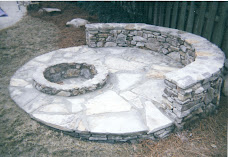
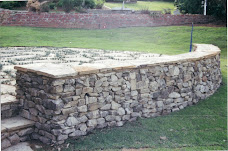
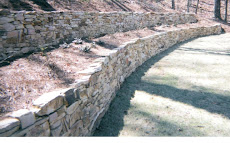
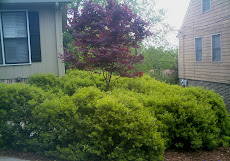
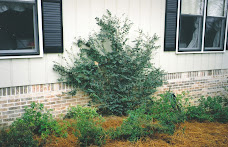
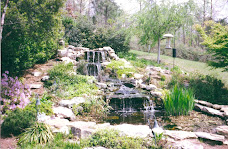
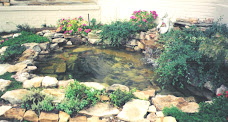
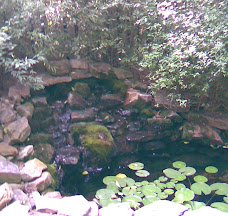
A small amount of stone (around 1 ton) was used on this particular project. The two stack stone walls are barely one foot tall, yet they significantly helped improve the overall appeal of this front yard.
Also, the sloping terrain was negated somewhat and a couple of planting spots were created where roots from nearby trees were making digging a bit of a chore, before.
In my opinion, bold statements can sometimes be made without commiting to a huge undertaking. 
Tuesday, March 8, 2011
Small implementations can make a big difference

Monday, March 7, 2011
Milk Can Water Feature
 This recent project involved using an old milk can that the homeowner had and incorporating it into a small water feature. The pond was placed on top of the patio, leaving the smallish, but quaint yard for plants and paths. A 'Bloodgood' Japanese maple was planted near the pond to provide a little shade and offer some interesting reflections on the water surface. A special shout out goes to Bella (featured in the video) and Dolce for their superb company.
Saturday, March 5, 2011
Kitchen Window Fun!

One reason I enjoy this time of the year is because that call to do a little fruit tree pruning will typically come in. What's fun about pruning fruit trees? Well, you've got a point there, but the side benefit is that you've got clippings that can be brought indoors to eventually bloom into quite a nice bouquet. Fruit trees, from my experience, are best, but you might have success with other flowering plants such as flowering quince, forsythia, and jasmine. Take a few stems as the flower buds appear to be beginning to swell and put them in a vase of water. Sit the vase in a window and enjoy! Experiment with different plants (what about azaleas or roses) and let me know if you're having success! 
Photo Right: This grouping of peach tree stems didn't show any color at all a week ago.
Sunday, October 17, 2010
A Foundation Planting that is Mindful of Erosion, Allergies, and Spacing

My most recent landscape excursion involved the installation of a front foundation planting in Hoover, AL. The home owners brought up a few concerns as we began talking about their landscape. For one, they had been battling some erosion issues at the sloping end of their home by the drive way. Also, there being issues with allergies in the family, plants for the landscape needed to be chosen to address those needs. Finally, the homeowners talked about wanting a landscape that wouldn’t become overwhelming for them. I was excited that they were aware that spacing plants too closely, while looking great initially, would eventually bring on pruning headaches and make the landscape seem like one giant hedge rather than a thoughtful gathering of distinguishable plants. PHOTO LEFT: Son, Jake, helps his dad with stone wall installation.
A brown stone wall was installed to negate the sloping portion of the front foundation. The wall, about 4’ tall at the drive, flows into what becomes a stone border for the entire foundation planting. The wall and stone border follows lines that are curved to help include a couple of small trees and some plant depth within the planting area. Also, a small stone bench is placed on the level side of the foundation for interest and also to add a little extra “weight” to help counter the stone wall on the sloping side of the house.
Choosing plants that are relatively allergy free required a bit of research. I was aware that plants with leaves that are heavily pubescent would be more prone to trigger an allergic reaction, so that was my starting point as I developed a plant list. I also used the book, “Allergy-Free Gardening”, by Thomas Leo Ogren. Mr. Ogren uses a 1 to 10 rating system to classify a plant’s allergy potential. Every plant used in this landscape was rated 1 (best) to 5, with most being rated 3 or better. The plant list:
(from left to right as you look at the house from the street)
1. Variegated Pittosporum
2. Bloodgood Japanese maple
3. Autumn fern
4. Shi-Shi Gashira Camellia
5. Harbor Dwarf Nandina
6. Snow Indian Hawthorne
7. George Tabor Azalea
8. Tonto Crape Myrtle
9. Sherwood Abelia
10. Pansies (probably Begonias in the Spring)
Spacing of the plants in this landscape was generous. Aside from avoiding a crowded landscape in the future, a well spaced landscape also encourages good air circulation between plants which is very helpful in promoting good plant health. Another feature of this landscape was the installation of landscape cloth. Landscape cloth is similar to landscape fabric, but better. No cloth or fabric is 100 percent effective, but it can typically cut down on about 95%, or more, of your weed problems during the first 5+ years of the life of a landscape and that is when you really need that kind of weed control.
It was enjoyable working on this project...The weather was great, all aspects of the job were fun, and working for the home owners was really a pleasure.
Friday, July 16, 2010
Fire on the Water: Fire Pit, Flagstone Patio and Sitting Wall on Lake Martin

A recent project sent me out near Pell City, Alabama, at the vacation home of some nice folks on Lake Martin. These snapshots were taken the day I finished the job. I'll add updates when some landscaping is done and a few pieces of furniture are added to the patio. Large patios, especially, benefit greatly with the addition of furniture, plantings, etc. 
I sure can imagine enjoying a nice, late fall evening, while sitting on a cushy lounge chair, sipping a favorite beverage, feeling the warmth of the fire and the coolness of the air as lake ripples sound off a relaxing melody! 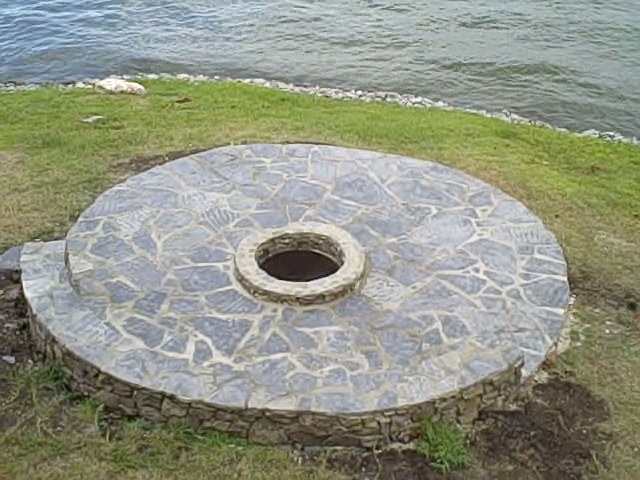
Thursday, July 15, 2010
Intimate gathering place: Fire Pit, seating area, small flagstone patio
Sometimes you don't need to go large. You lack space or having a huge area doesn't create the cozy feeling you desire? What better way to create a warm space than to install a fire pit? I completed this project about 4 or 5 years ago. One thing about a well-built stone feature...it's there for a long, long time...that's potentially a lot of nice evening fires! 
Tuesday, June 1, 2010
Turn your surface drainage problems around!
Here's a little drainage project I took on a few months ago and it has really worked out. Prior to installing what essentially amounts to a dry creek bed, my client was experiencing wash out of his mulch during heavy rain.
Several thought processes are required when eliminating a surface runoff drainage problem. First, you want to determine what type of solution will work best. French drains clearly would not be appropriate (they are, in fact, overly used, often, poorly installed, and seldom do they correct the problem); A basin w/ grate and underground piping would work, but a 12" thick, concrete retaining wall was in the path of the runoff outlet making this option an impossibility. So, surface drain (ie. dry creek bed) was the ticket.
Second, you need to anticipate the amount of water that might run through your system and create it so that it is large enough. Also, you must determine the optimum point of runoff entry. In this case, that was pretty obvious. What was neat about this project was being able to turn the water movement to where I wanted it to go...quite nearly a 180 degree turn!
Lastly, consider aesthetics. Sure, it's a drain system. But that doesn't mean it can't be perty!
Subscribe to:
Posts (Atom)